Sunday, January 1, 2023

huge study of covid shots says....


STORY AT-A-GLANCE

  • Dr. Kathryn Edwards, a member of Pfizer’s data safety monitoring board (DSMB), was previously a paid adviser to Pfizer. DSMBs are supposed to be independent, and aren’t if members have previous relationships with the company
  • German autopsies found “highly unusual tissue inflammation” in people who died shortly after getting the jab, and investigators suspect the inflammation observed would be fatal. They also found spike protein in the tissues of the deceased, but not another key part of SARS-CoV-2. This suggests the actual virus was not part of the problem; the only possible source of the spike protein was the jab
  • Data from the German health insurance provider BKK, which covers about 10.9 million Germans, show 2.05% of COVID jab recipients sought medical care after their jab
  • The largest German statutory health insurance dataset, which encompasses 72 million Germans, show massive increases in sudden and unexpected deaths after the COVID jabs rolled out
  • December 13, 2022, Florida Gov. Ron DeSantis petitioned the Florida Supreme Court for a statewide grand jury investigation of crimes and wrongdoing committed against Floridians related to the COVID-19 jabs. He also established an independent Public Health Integrity Committee to analyze and assess federal health guidance before they’re implemented in Florida

Contrary to the official narrative (and hence popular belief), the COVID shots have no demonstrated safety. In Episode 298 of The Highwire, Del Bigtree interviews attorney Aaron Siri about the various lawsuits his firm has brought to reverse COVID jab mandates.

Siri describes a recent deposition of Dr. Kathryn Edwards, a world-leading vaccinologist who sat on Pfizer’s data safety monitoring board (DSMB). This five-member committee oversaw the safety of Pfizer’s jab. A DSMB is supposed to be an independent group of experts, whose responsibility it is to monitor patient safety and treatment efficacy data while a clinical trial is ongoing.

Pfizer’s Not-so-Independent Safety Monitoring Board

As noted by Siri in the deposition, since the DSMB is supposed to be independent, it’s crucially important that all the members of that board have no potential conflicts of interest and are in fact truly independent of the drug company whose product they’re evaluating.

In the case of Edwards, she was a paid adviser to Pfizer before she was hired (by Pfizer) to be on the DSMB for their COVID jab. According to Edwards, this fact is irrelevant, because that prior relationship did not influence the work she did on the board.

“I say what I believe based on my expertise,” she told Siri. “So, you don’t think financial incentive can sway people’s judgment at all?” Siri asked. “It does not sway my judgment, Sir,” she replied. “Then why have an independent DSMB?” Siri asked. “Why doesn’t Pfizer just have some of its employees on it?”

“Because we are independent; we are independent from Pfizer in this assessment,” she replied. But just how can an independent advisory committee possibly be “independent” if members have prior relationships with the company?

Another noteworthy tidbit from that deposition was Edwards’ comment that she reviewed “lots of reactions and adverse events” from the COVID jab trial. Yet the public has continuously been told there are no bad reactions. So, what was she looking at? And why, if there were “lots of reactions,” did the DSMB conclude that there are no safety concerns?

Of course, we know at least some of what she was looking at. Pfizer trial documents1 have been released showing the company amassed nine single-spaced pages’ worth of “adverse events of special interest” (see pages 30 through 382), including 1,223 events with fatal outcomes between December 1, 2020 and February 28, 2021 alone.

A whistleblower who worked on Pfizer’s Phase 3 trial has also come forward with evidence showing data were falsified, patients were unblinded and follow-up on reported side effects lagged way behind. Why didn’t any of these issues concern the DSMB? Was it because there really was no independent DSMB?

What German Autopsy Data Have Revealed

In a mid-December 2022 Substack article, the anonymous writer who goes by the moniker “A Midwestern Doctor” reviewed German autopsy data, which demonstrate:3

  • The presence of “highly unusual tissue inflammation” in people who died shortly after getting the jab. As noted by the author, “Pathologists had not observed this phenomena before the COVID-19 vaccines, and they suspected this inflammation would be fatal.”
  • The presence of COVID spike protein in the tissues of the deceased, whereas another key part of the SARS-CoV-2 virus was absent. This suggests the actual virus was not part of the problem; the only possible source of the spike protein was the jab.

The most recent and “most definitive” study on this subject, according to A Midwestern Doctor, examined 35 people who died within 20 days of getting the COVID jab. After thorough autopsy examination, 10 of the deceased were determined to have died from causes other than the jab.

Among the remaining 25, most died from causes that, in general, have frequently been linked to vaccination. Five died from myocarditis, which could potentially be linked to the shot. In three of those five cases, the COVID jab was determined to be the definitive cause of the myocarditis that led to their death.

As noted by A Midwestern Doctor, “These results are very important for convicting the vaccines if it can also be proven that a large number of unexpected deaths are occurring following vaccination.” As it turns out, that’s exactly what excess mortality data tell us.

German Insurance Provider Data Show Rise in Doctor’s Visits

A Midwestern Doctor also cites data from the German health insurance provider, BKK, which covers about 10.9 million Germans. One of the BKK board members, Andreas Shöfbeck, discovered concerning trends in their data, which he sent to the Paul-Ehrlich Institut, an agency of the German Federal Ministry of Health.

No good deed goes unpunished in the era of COVID censorship, however, so Shöfbeck was summarily dismissed from the board as thanks for his contribution to public health and safety. The BKK dataset showed 2.05% of COVID jab recipients sought medical care after their jab. A Midwestern Doctor continues:4

“This concerning safety signal prompted … the AfD [Alternative for Germany, a conservative political party] … to file the German equivalent of FOIA [Freedom of Information Act request] for the rest of the insurance data …

Recently AfD obtained AOK Sachsen-Anhalt’s data, which once analyzed, demonstrated that many of the conditions we associate with COVID-19 injuries noticeably increased when the vaccination campaign initiated … [C]onditions which rose five-fold or more were:” 


Largest Insurance Dataset Reveal Rise in Sudden Deaths

The larger statutory health insurance dataset from KBV, which encompasses 72 million Germans, show massive increases in sudden and unexpected deaths after the COVID jabs rolled out.

The following graph is from a press conference presentation by data analyst Tom Lausen (see video below; it’s in German, but you can enable English subtitles).5 No mainstream media attended the press conference.
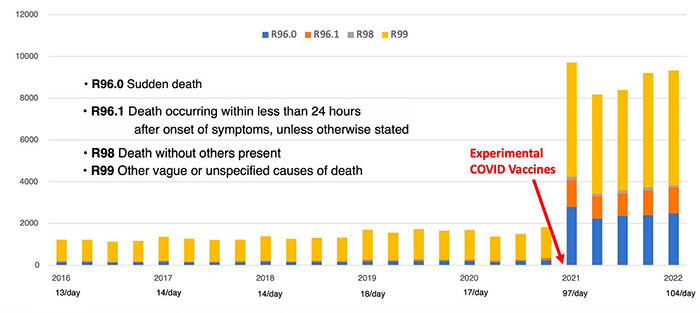

“… one way that individuals have analyzed the unusual changes in health following the vaccination campaigns has been to assess how far they fall outside of the expected range of variation …

I did a quick calculation for the above graph and found that 2021’s increase from 2016-2020 was 37.7σ [sigma], while 2022’s was 41.0σ. This is quite a big deal (the rarity of an event happening by chance increases exponentially as the σ increases).

For context, a 7σ event has a 1/390,632,286,180 chance of spontaneously occurring (it is thought to occur once in a billion years) … (I was not able to find a reference on the probabilities for the even higher σ events observed here).

Given these numbers, it is very difficult to argue that these events were not caused by something. In this regard, we are also quite fortunate that while the vaccines were rushed to the market over a period of time far too short to establish safety, that process still took a year.

Because of this lag, it is possible to refute the commonly cited argument that these changes were due to COVID-19 or the lockdowns, as these only occurred in 2020 …”

Dramatic Rise in Heart-Related Fatalities

Lausen also presented a graph for German fatalities per quarter involving cardiac problems.7,8 These six death certificate codes all correspond to “sudden deaths” with cardiac cause. As you can see, heart-related mortality more than doubled in the first quarter of 2021 from the year before, and nearly tripled from the five-year average.

Some have argued that since few shots were given in early 2021, heart-related deaths would not have increased until the second quarter if there was a correlation between the two. However, other data show there was a rapid rise in COVID jab doses administered during the first quarter of 2021 (see graph below), so it’s not outside the realm of possibility that there is a correlation.

Also, as with all-cause mortality, the fact that heart-related deaths did NOT spike during 2020 suggests COVID-19 had nothing to do with the rise that occurred in the first quarter of 2021.

Data Analyst Calls for Immediate End to COVID Jabs

In the conclusion of his presentation, Lausen calls for the immediate suspension of the COVID jabs until correlation between the shots and death can be conclusively ruled out. He also calls for:9

  • Autopsies on all who died suddenly to determine what the massive increase is due to
  • Mandatory recording of the COVID jab status of all deceased individuals, and the brand used, and regular publication of these data
  • Immediate evaluation of the KBV data by German health authorities
  • Informing all doctors and the population at large about the increase in diseases being reported post-jab
  • Regular publication of KB e V data linked with COVID jab data held by the Paul Ehrlich Institute and the Robert Koch Institute (Germany’s public health institute)

The Shots Also Have Negative Effectiveness

In addition to not being safe, by any standard, the COVID shots are also negatively effective, meaning after 90 days, both Moderna’s and Pfizer’s shots make you more susceptible to COVID.

As shown in the graphic below, Danish data reveal Omicron cases among the jabbed rose dramatically after three months for both injections, giving Pfizer a negative effectiveness of 76.5% at 90 days’ post-jab and Moderna a 39.3% negative effectiveness.

“If you’ve been vaccinated, and feel like you’ve been getting sick more often than your unvaccinated friends, your impression is correct … The only rational, scientific, ethical, and moral response is to #StoptheShotsNow for everyone under 50 who is healthy. Anything less is profiteering, politics, or personal failure. Or assault and/or homicide if you’re a doctor.”

Florida Governor Calls for Grand Jury Investigation

I’ve reviewed data on side effects and excess mortality in the U.S. in several previous articles, and Florida Gov. Ron DeSantis recently did what many of us have been calling for in light of those data.

December 13, 2022, he petitioned the Florida Supreme Court for a statewide grand jury investigation of crimes and wrongdoing committed against Floridians related to the COVID-19 jabs.11 According to the governor’s press release:12

“The pharmaceutical industry and the FDA have refused to release patient-level data for independent researchers.

Meanwhile, the COVID-19 vaccines produced by Pfizer and Moderna have received FDA approval for pediatric and adult patients and continue to be marketed as safe and effective, even though the vaccines do not prevent transmission and adverse events have been minimized and disregarded by the Biden Administration and Big Pharma.

In response, Governor DeSantis has filed a petition to impanel a statewide grand jury to investigate crimes and wrongs in Florida related to the COVID-19 vaccines and further recommend enforcement methods.”

Florida Establishes Independent Public Health Committee

DeSantis is also implementing autopsy surveillance of post-jab sudden deaths, and has established a Public Health Integrity Committee, an independent group of expert researchers “charged with assessing federal decisions, recommendations, and guidance related to public health and health care … to ensure that Florida’s public health policies are tailored for Florida’s communities and priorities.”


Thursday, November 3, 2022

apocalypse now


https://fancy4work.com/earth-has-just-started-emitting-giant-magnetic-waves-from-its-core-marie/


https://siamtoo.com/18360/


https://jackie88.com/1675/earths-magnetic-north-pole-continues-drifting-crosses-prime-meridian/


https://fancy4work.com/the-earth-just-shook-like-a-bell-for-20-minutes-and-no-one-knows-why-marie/


https://www.earthdata.nasa.gov/learn/sensing-our-planet/matter-in-motion-earth-s-changing-gravity 


https://jackie88.com/2191/huge-sunspot-pointed-straight-at-earth-has-developed-a-delta-magnetic-field-2/


https://fancy4work.com/a-burst-of-gravitational-waves-hit-our-planet-astronomers-have-no-clue-where-its-from-marie/


https://theancientzen.com/the-earths-rotation-is-changing-speed-we-should-be-very-worried/


 https://theancientzen.com/earth-is-passing-through-a-dark-matter-hurricane-right-now/


UPDATE nov.14 2022


⚠️ OFF THE CHART AGAIN - POLE SHIFT WARNING ⚠️

Over the year the North Pole forms a circle when viewed from above the ecliptic. This graph shows Earth's wobble as seen from above. (See charts and graphs in comment section.)

The axis dots on the graph form a circle and show the years axis tilt variation. This chart shows the wobble, tilt and drift from Earth's normal axis point from 2013 to today.

Earth's path of 2021 is in brown.
Earth's path of 2022 is in yellow.

This year we see Earth is making an extremely wide turn in its radius and is at its furthest distance EVER from its normal position from 2013, (its Zero Axis point of 2013).

This wobble, tilt and drift is directly connected to Earth's ongoing magnetic pole reversal, pole shift, failing magnetic field, magnetosphere disturbances, atmospheric compression, jet stream collapse and weather extremes.

___________________________________________

Earth Axis Tilt Chart:

Data plotted on the graph is from the Paris Observatory IERS Centers.

The little black arrows indicate the position of where the x, y pole positions were the years prior on June 22. That's the last day this chart was updated by the previous researcher.
Note: "The reason the arrows are on the graph is so we can see the difference in wobble from year to year (the distance to no wobble in the center).

As well as whether the timing on that same day each year forms a straight line to the center (rising and setting at the same place each year) or if the timing of them is ahead or behind each other (rising and setting in a different place each year).

The center that says zero axis wobble does not mean no tilt. The axis itself is tilted and produces the seasons, so even with no wobble we still have seasons. The drift really is the slight variations in the axis which is already tilted and wobbling."

Monday, October 17, 2022

how to make electro-colloidal gold


How-to make electro-colloidal gold

Making Colloidal Gold 
Purpose:

The purpose of this page is to show how to make Colloidal Gold. using an electrolytic process to make gold chloride (AuCl3), and then to reduce the resultant gold chloride to colloidal gold by means of a sugar based reducing agent and sodium citrate stabilizer.

 see video here https://youtu.be/HkljxNU2aZY 

Materials:


You will need the following materials.
    1)    .999 fine gold RIBBON, about 6" to 1 foot in length.
http://www.riogrande.com/Product/22K-Yellow-Gold-1-8-Plain-Bezel-Wire-Dead-Soft/609218 
    3)    Sodium Chloride (Table salt)  
    3)    Sodium Citrate (Also called tri-sodium citrate)  1lb $5.95              http://thechemistryconnection.com
    4)    Ordinary Corn Syrup.
    5)    Power supply capable of supplying ordinary house current 110vac
    6)    common cheap coffee maker
    7)    Distilled water.
    
Warning:    

If you are not experienced working with electricity, get assistance, or do not perform this procedure.   110vac is lethal.

Stock Solutions: 
   
To make the Sodium Chloride  solution,  weigh 0.3 grams of table salt, and dissolve it in distilled H20 to make 100 ml of  stock solution. 

 To make our Citrate stock solution, weigh out 1.47 grams of Sodium Citrate and dissolve it in distilled H2O to make 100 ml of stock solution.

The Electrodes:


For the electrodes use .999 pure gold ribbon. IONS flow best off sharp edges and points. ANY gold will work but ribbon works best.
Power Supply:

The power supply should be able to supply ordinary house current of 110vac. literally all that's needed is two wires with a house plug on one end and alligator clips on the other.

There is a minimum voltage for the process to work, based on the electrochemical series.  It is only about 30 volts.

MAKE CERTAIN that you plug in the electricity LAST and NEVER TOUCH THE DEVICE WHILE IT IS ENERGIZED.

i prefer to put a SWITCH in the circuit just for added safety.

The Process:

Arrange the apparatus so that the carife is on the hotplate.
Add 250ml of distilled water to the coffee maker.

Suspend the electrodes in the carife and bring the water to a boil.  Leave the power supply off. i simply bend the elements over the edge of the carife.

With the power supply turned off, connect the gold electrodes to the supply terminals,  Make sure that there are no short circuits, and that there is no exposed wiring which could cause a high voltage shock.  Do not power it up yet.

Bring water to a boil.

 add 15 ml ( 3tsp ) of stock table salt  solution to the beaker. stir . i use a swizzle stick or a chop stick. non-conducting material just to be safe.

Add 2 drops syrup to the beaker Or about the amount picked up by immersing the end of a chopstick 1/4 inch into the syrup and letting the excess drip off.

Add 5 ml ( 1tsp ) of the stock Sodium Citrate solution to the beaker.

turn on the power source

Within minutes, a red tint should start to appear.

When the desired color depth is produced, or no more color change is detected, turn off the power first, then remove the electrodes.  Top off the water to restore it to 250ml.  You should now have red colloidal gold.  Filter, and bottle.

Half Reactions:


   Cathode:

        6NaCl + 6e --> 6Na +6Cl-           Chloride ion travels to Anode where it combines with gold
            6Na + 6H20 --> 6NaOH +3H2 (which bubbles off as hydrogen gas)
            6NaOH --> 6Na+  +6OH-       New hydroxyls journey to anode continuing electrolysis of water.
        Au+++  +3e -->  Au                 We don't want this to happen as it merely produces gold sludge on the cathode
        4H20 +4e -->  2H2 + 4OH-    This reaction may not happen because of the preference to electrolyze the potassium


    Anode:

        6Cl-  --> 3Cl2 + 6e
            2Au +3Cl2 --> 2AuCl3      Gold is liberated as gold chloride
        4OH-  --> O2 + 2H2O + 4e    Oxygen gas is liberated as hydroxyl ions are oxidized


    Secondary Reactions:

        AuCl3 is known to react with the  Cl- of the NaCl to produce Chloroauric acid
                - So -
        AuCl3 + NaCl +H2O -->  HAuCl4 +NaOH


   Sodium Citrate Chloroauric Acid Reduction Reaction:

       4HAuCl4 + 12C6H7NaO7 +6H2O  --> 4Au + 12NaCl +4 HCl + 12C6H8O7 +3O2
 

Further Observations:

While the spacing between the electrodes does not affect the reactions, it does alter the amount of voltage needed from the power supply to produce a fixed amount of current.  The closer the electrodes are, the lower the voltage needed. However, closer electrodes are detrimental in that the gold ions have less distance to travel before contacting the negative electrode.  Any gold ion that contacts the negative electrode is wasted.  We wish the gold ions to encounter and react with the citrate or peroxide reducing agents before touching the cathode.  Therefore higher voltage is beneficial in that it allows the electrodes to be spaced farther apart while maintaining a reasonable electrical current. that is why i use 110vac. not only does it afford more rapid making but also emmits from BOTH elements.
 
Actual voltage is inconsequential to the electrochemistry.  What matters is current (amperes).  (See Faraday's Laws)  As you can see from the half reactions, it takes 3 electrons to liberate 1 atom of metallic gold.  Additional electrons are required for the inevitable electrolysis of water.  

As the Au+++ ions enter solution, they migrate to and are pulled to the cathode because of the electric field between the electrodes.  If the Au ions reach the cathode, they will be reduced back to metallic gold, which is not what we want. (This is the basic electroplating mechanism).  By adding the reducing agents (Corn Syrup, and Na-Citrate) at the start of electrolysis, the Au ions have a high probability of finding a molecule of the reducing agent before reaching the cathode.  When this happens, the ionic charge is neutralized, and free metallic gold appears in the solution instead of on the cathode.  However, a small amount of the Au ions may be reduced at the cathode, causing some loss gold particles.

Note that the sodium atoms are essentially trapped at the cathode.  As soon as they are reduced to sodium metal, they immediately react with water to again produce sodium hydroxide which immediately ionizes, allowing the sodium ion to be reduced to metal and start the cycle all over again.  This in turn produces a steady stream of hydroxyl ions moving towards the anode to be turned into oxygen gas and water again.  At this point, I do not know how to determine the ratio of the sodium cycle to the gold cycle.  
A similar occurence seems to happen with the Cl- ion at the anode.  As soon as the Cl- reacts with gold to produce AuCl3 it would immediately ionize, again producing Cl- ions attracted to the anode.  

The stoichiometry above assumes all of the chlorine will combine with the gold to produce gold chloride.  Experimentation shows that is not so.  In fact, it is necessary to at least double the amount of NaCl to achieve CG with the color density of a known 50ppm sample produced by reacting commercial gold chloride with citrate per the Turkevich method.  Therefore, it must be assumed that the chlorine is sequestered somewhere or it escapes with the oxygen produced at the anode before it can react with the Au.
STUDIES

Monday, September 5, 2022

CHOLESTEROL


Cholesterol is a word that strikes fear into the heart. But does it also strike disease? Because here’s the curious thing: having a high cholesterol level is associated with living a longer life, especially if you have heart disease. Confused? Of course you are! Welcome to the cholesterol paradox.

The term “cholesterol paradox” was coined as early as 2006 (if not before), when a study of data collected from 24 countries, involving nearly 11,000 patients with heart disease, found that “Low cholesterol levels were associated with worse prognosis in patients with acute heart failure.”

That was just the start of it. Since then, many studies have been published that discuss this baffling observation, one that has been replicated many times.

Indeed, raised total cholesterol has been shown to be a predictor of survival — in a study of 114 patients with chronic heart failure, the chances of survival increased by 25% for each mmol/l increment in total cholesterol. Similarly, it has been found that most — nearly 75% — of people who are admitted to hospital with heart attack have normal cholesterol levels.

How is it possible to make sense of all this? Easy. Just call it a paradox and ignore the cognitive dissonance.

Nobody argues that cholesterol is essential to life. This fat-like substance, made in the liver, is present in every cell of the body. It is needed to make hormones and to make vitamin D. It is a component of the cell membrane and plays a key role in the immune system. The brain has the highest concentration of cholesterol in the body, where it is involved in nerve transmission and memory recall. So vital is it that the brain makes its own supply.

Drugs designed to reduce cholesterol in the body — statins — are among the most prescribed in the world. In 2019, Atorvastatin was the most widely prescribed drug in both the UK and US.

“The recently presented ACCELERATE trial dumbfounded many experts by failing to demonstrate any cardiovascular benefit of evacetrapib (cholesterol-lowering medication) despite dramatically lowering low-density lipoprotein cholesterol and raising high-density lipoprotein cholesterol in high-risk patients with coronary disease.”

Unpacking the paradox

One way to decipher this enigma is to talk about “good” and “bad” cholesterol. Yet this too is misleading. There is only one type of cholesterol, and it’s called cholesterol. There are, however, different types of cholesterol transport systems.

Cholesterol is transported around the body by different protein carriers, known as lipoproteins. There are several types, the main ones being high density lipoprotein (HDL), low density lipoprotein (LDL) and very low-density lipoprotein (VLDL).

HDL is assumed to be “good” because it transports cholesterol away from the arteries and to the liver, for disposal.

LDL is assumed to be “bad” because it transports cholesterol from the liver to the rest of the body — including the arteries, where it is a component of arterial plaques. That is why cholesterol is vilified as the enemy of heart health. (Plaques contain, among other things, calcium, but nobody suggests you avoid calcium.)

Arterial plaques can build up, causing narrowing of the arteries and a condition called atherosclerosis. Eventually a clot can break off, blocking flow to the heart and causing a heart attack.

So far, so neat and tidy. It’s only when you delve deeper that it all starts to get rather messy.

Even though LDL is the one with the bad reputation, low levels of LDL are linked to higher overall mortality in patients with heart failure. If you want to survive, you might be better off with high levels of not-so-bad-after-all LDL cholesterol.

Similarly, people with high cholesterol, including high LDL cholesterol, are less likely to have atrial fibrillation. Atrial fibrillation (AF) is irregular, sometimes rapid heart rhythm, which can cause blood clots in the heart. It also increases the risk of stroke and heart failure.

“This research adds to the body of evidence which suggests an inverse relationship between cholesterol levels and AF — the “cholesterol paradox” for AF.”

It’s all about the ratio…

Lowering LDL cholesterol has no substantial effect on reducing heart attacks or death. Which is not to say that cholesterol doesn’t matter; it does.

The key issue is the ratio of total cholesterol to HDL. This is now considered to be a more important, stronger predictor of heart attack in both men and women, even though “the clinical use of the ratio is often overlooked”.

How do you calculate your ratio? Simple — just divide your total cholesterol figure by your HDL figure. The optimal range is 1.0–4.8. These days test results usually include the all-important ratio. When you next get tested, be sure to ask about this.

…..and the fat

While you’re about it, ensure also that you have your triglycerides measured; triglycerides are a strong risk for cardiovascular disease. Serum triglyceride is the fat circulating in your blood and high levels (over 1.68mmol/L) increase your risk of coronary heart disease and stroke.

Where diet comes in

And here’s another paradox to scramble your brain. Eating saturated fat does not raise blood fat. It does increase both LDL and HDL cholesterol, but without changing the ratio of total cholesterol to HDL.

Despite the lack of evidence to indict it, the fear of saturated fat persists. To resolve this contentious issue once and for all, the Journal of the American College of Cardiology published, in 2020, a thorough, “state-of-the-art” review into the relationship between saturated fat consumption and cardiovascular disease.

The researchers discovered that most analyses and trials found that not only was there no benefit in reducing saturated fat to minimise the risk of cardiovascular disease, it was actually protective against stroke. The conclusion of this review was:

“The recommendation to limit dietary saturated fatty acid (SFA) intake has persisted despite mounting evidence to the contrary.”

So what does increase levels of triglycerides, and therefore risk of heart disease?

The answer is carbohydrate.

The best way to lower your risk of heart disease and early death is to reduce your intake of carbohydrates, especially sugar and refined carbohydrates.

When you eat a low carbohydrate, high fat diet, your triglyceride level goes down. This is exactly what you want. Do the opposite — eat a high carbohydrate, low fat diet — and your blood fat rises and your HDL decreases. That is the effect of insulin, or rather insulin resistance.

Insulin resistance is a pre-diabetic state, where the body is no longer able to respond adequately to all the glucose circulating in the blood.

“…the conventional dietary advice on lowering cholesterol by reducing saturated fat intake is not just wrong, but has also likely worsened the risk of heart disease by fuelling the single most important root cause of coronary artery disease and heart attacks: insulin resistance.” (Dr Aseem Malholtra: A Statin-Free Life.)

A review of the evidence surrounding sugar consumption and its role in the development of coronary heart disease found “relatively consistent evidence” of an association between sugar intake and the risk of developing cardiovascular disease.

“To reduce the burden of CHD, guidelines should focus particularly on reducing intake of concentrated sugars, specifically the fructose-containing sugars like sucrose and high-fructose corn syrup in the form of ultra-processed foods and beverages.”

These are the foods that increase your risk of developing insulin resistance. Diabetic patients are more likely to have coronary atherosclerosis than non-diabetics and more likely to die from heart disease. But even without diabetes, insulin resistance puts you at greater risk.

There are so many “paradoxes” in nutrition that they are becoming the norm. Perhaps you’ve heard of the French paradox — the observation that the French have one of the highest consumption rates of saturated fat in Europe, but a relatively low rate of heart disease.

However you view all these contradictions, something clearly isn’t working, because “The global campaign to lower cholesterol by diet and drugs has failed to thwart the developing pandemic of coronary heart disease around the world.”

Indeed it has. A re-examination of entrenched beliefs about diet, heart disease and longevity is surely long overdue.

As I mention above, cholesterol is essential for brain health. Deficiency is linked to a number of diseases, including dementia.


For years, we have been fed a narrative that a high level of LDL cholesterol is responsible for causing heart disease, and therefore lowering LDL cholesterol to the lowest level possible is a good thing.
The current recommendations are to reduce that number to less than 70 mg/dL. For a report that appeared in the journal Neurology, researchers studied the association between LDL cholesterol and brain bleeding risk. More than 96,000 subjects who had never had a stroke, heart attack, or cancer were studied.
Editor's Note: Dr. Crandall Reveals the Secret to Normal Cholesterol
Averages of LDL cholesterol were correlated to the development of heart disease. Subjects with LDL cholesterol levels of 70 mg/dL to 99 mg/dL had a similar risk of heart disease as those with levels greater than 100 mg/dL.
Those with LDL levels less than 70 mg/dL had a significantly higher risk for developing heart disease than those with LDL levels of 70 mg/dL to 90 mg/dL.
For those with LDL levels of 50 mg/dL to 69 mg/dL, there was a 65% higher risk, and there was a 169% higher risk for those with LDL levels below 50 mg/dL.
I’ve been saying this for years: Using toxic medications to lower cholesterol levels as much as possible does not make sense. This study found a significantly higher risk of brain bleeds when LDL levels are lowered to the recommended ranges.
Statin drugs help about 1% of people who take them. Now we have new cholesterol-lowering medications that target LDL cholesterol receptors. They poison a crucial enzyme which results in a drastically lower LDL cholesterol.
But the side effects of doing this include serious, life-threatening infections, cancer, and now brain bleeds.
As I wrote in my book, “The Statin Disaster,‒ both statins and LDL-lowering medications are fraught with side effects and have poor efficacy.
If your cholesterol levels are too high, it is best to search for a reason why this is occurring and avoid taking toxic medications that simply fail most who take them.


For decades, statins—the most common cholesterol-lowering medications—have been recognized as a lifesaver for those with heart disease. While statins have revolutionized heart health in a positive way, some studies highlight the lesser-known concerns of the medication: energy-sapping, increased diabetes risk, and, for many people, muscle pain.

The Puzzling Link Between Statins and Insulin Resistance

A recent systematic review of 11 epidemiological studies with nearly 47 million participants found associations between statin use and decreased insulin sensitivity, as well as insulin resistance—both significant factors for developing Type 2 diabetes. Additionally, statins were found to reduce glycemic control and elevate fasting glucose levels.

Experts are uncertain about the precise mechanism through which statins might impact insulin resistance, considering their advantages, such as lowering inflammation, decreasing oxidative stress, and enhancing endothelial function—all of which actually improve insulin sensitivity rather than diminish it.

A 2021 study published in the journal Arteriosclerosis, Thrombosis, and Vascular Biology also found that statins can increase the risk of Type 2 diabetes, but how was unclear. In weighing the potential risks of statins, however, most researchers and health care professionals still believe them to be more beneficial than harmful.

“It is generally viewed that the strengths of lower cholesterol by a lot outweigh a modest increase in insulin resistance,” Michael Snyder, a genetics professor and chair of the Genetics Department at Stanford University School of Medicine, told The Epoch Times.

But the double-sided nature of statins remains unclear to researchers, added Dr. Snyder, who has coauthored multiple studies investigating the correlation between statin usage and insulin intolerance.

Lifestyle factors like obesity also play a major role in insulin resistance. Insulin resistance is often associated with high body weight, which individuals can reduce to potentially offset statins’ effects, Dr. Snyder said.

Why Do Statins Drain Energy?

Fatigue and muscle pain seem to be common with statin use. A study of over 350 statin users found that 93 percent reported muscle pain and fatigue, while 85 percent reported weakness.

“This is of no surprise because of the well-documented effects that statins have on Coenzyme Q-10 (CoQ10), which is a primary cofactor for mitochondrial function,” Dr. Node Smith, a board-certified naturopathic physician, told The Epoch Times. Mitochondria create energy for the entire body at the cellular level. Therefore, in practical terms, statins can deplete the body’s cellular energy by depleting CoQ10, he added.

A letter to the editor published in the British Journal of Clinical Pharmacology noted that people taking statins who also supplemented with CoQ10 were less likely to experience chronic fatigue.

Dr. Smith said many of his patients who have taken statins long-term have reported experiencing persistent muscle pain, weakness, fatigue, and brain fog. “Some of these patients are avid athletes and simply are confused why they can no longer work out,” he added. “If I see this presentation in someone on a statin medication, I will almost always assume the statin is at least a contributing factor and discuss with the patient its removal and replacement with another therapy.”

Is Vitamin B3 an Alternative to Statins?

Statins are commonly used alongside niacin (vitamin B3), recommended for over 40 years to prevent heart disease due to the vitamin’s positive impact on lipid levels.

Niacin is the most common and effective treatment that replaces statins, according to Dr. Smith. “Of all the pharmaceutical medications I’ve helped people get off of, statins are the easiest, least concerning, and patients typically have the best results with—because it is not uncommon for them to feel almost instantly better.”

Niacin decreases LDL cholesterol, which can build up plaque in arteries when levels are too high. It also increases HDL cholesterol, which absorbs other forms of cholesterol in the bloodstream and carries it back to the liver for removal, according to a clinical trial of over 300 people. Additionally, niacin lowers triglycerides, a type of fat in the blood.

Optimized niacin therapy costs patients $15 to 30 per month and is worth trying before statins, Dr. Smith added.

Studies have found that combining niacin and statins may outperform statins alone. Dr. Smith has observed similar results in his practice, although some studies suggest otherwise.

Niacin fell out of favor due to the side effect of niacin flushing, which produces a slight prickly heat sensation for about 30 minutes and can be quite concerning and uncomfortable for some people, he said.

About 15 years ago, wax-coated niacin tablets were developed. They allow high doses of niacin to be delivered while reducing flushing for most people, according to Dr. Smith. Side-effect management methods like taking niacin with food or baking soda can also help.

However, Dr. Smith cautioned that people with familial hypercholesterolemia, a genetic disorder, may need more aggressive therapies, potentially including statins.

Major headlines in the UK!
The Medicines and Healthcare Products Regulatory Agency released figures that call for an urgent review of the safety of cholesterol lowering medication.
The latest figures in the UK show over 20,000 reported side effects, including over 220 deaths.
One of the most commonly reported side effects is muscle damage. Not only is it debilitating, but it can also be fatal.
In a completely separate study in the US, cholesterol lowering drugs were linked to 3039 cases of rhabdomyolysis (where the body is poisoned by muscles breaking down leading to acute kidney failure), where a further 240 patients died.
Dr Malcolm Kendrick says, "These reports are just the tip of the iceberg as most doctors do not report side effects. The data uncovered is very alarming and shows the risks of these drugs have been downplayed. For many patients the benefits of statins may not be worth the harms.”
And other doctors agree. Dr David Diamond, a professor in molecular pharmacology, and Dr Uffe Ravnskov, an expert in cardiovascular disease, concluded in their study published in Review of Clinical Pharmacology:
“The adverse effects suffered by people taking statins are more common than reported in the media and at medical conferences.
“Increased rates of cancer, cataracts, diabetes, cognitive impairments and musculoskeletal disorders more than offset the modest cardiovascular benefits of statin treatment.”
Not only that, most people don't realise that cholesterol HEALS. If we do have inflammation, if we do have calcification of the arteries, cholesterol is likely to rise. It is trying to heal the damage. Taking the cholesterol away is taking away our protection from heart disease! And, it is generally combined with a prescription of a low-fat diet, which again, increases our risk for heart disease.
The Masai people in Kenya saw vegetables as "food for cows." Their diet was meat, meat, and more meat (full fat, they didn't throw anything away). And they consumed gallons of Zebu milk every day; they consumed around 70% of their calories as fat. Researchers expected their blood cholesterol levels to be through the roof. But they were the among the lowest ever measured. And, they had no inflammation, and no sign of modern chronic diseases like heart disease.